Showing posts with label queen rania. Show all posts

Friday, March 09, 2007

International Womens Day

March 8 is International Women’s Day, so I would like to acknowledge four women who are using their talent and energy to help others.

First, of course, there is the remarkable Gemma Sisia, visionary and founder of the School of St Jude.


Gemma was a ‘mere slip of a girl’ in her 20s when she took the first steps towards establishing the school. Under her care, it is growing by about 150 students a year. In time, it will serve 2,500 children from kindergarten to Yr 12. Just running a quality school in one of the poorest countries in the world is challenging, but this school is entirely supported by fund-raising. Last year the budget was AU$1million – a testament to her talent, determination, persuasiveness and good sense!

Michaelle Jean is the Governor General of Canada and what a remarkable voice she brings to this prominent role. For International Womens Day, she chose to travel to Afghanistan, to bring attention to the needs of women who are enduring the difficult circumstances of life in a broken country.

Michaelle Jean with President Karzai on 8 March 2007

Throughout these dark, terrible years, I often imagined the terror of their daily lives and I cried out inside with indignation for all those who could not. For me and for so many others, the hand they were dealt was unacceptable. To attack the dignity of women is to fly in the face of life itself; it is to make a mockery of humanity. Still today, Afghan women face harsh realities on a daily basis. I know that less than 10 per cent of Afghan women give birth with a qualified person present, and that these dangerous conditions are responsible for over 50 per cent of the deaths of Afghan women of child-bearing age. As a mother, it pains me to know that the infant mortality rate in Afghanistan is close to 20 per cent.

I am here, with Afghan women, to tell them myself how convinced I am that we need to take action on their behalf, while remaining respectful of their needs and aspirations.

Meryl Streep has achieved the height of her profession and become world famous in the process.
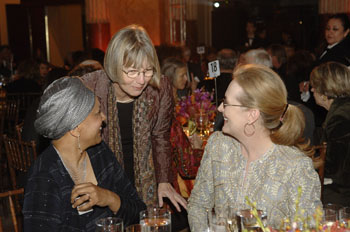

Here she is with Nancy Birdsall and Geeta Rao Gupta as a special guest at the gala event presented by the International Center for Research on Women to commemorate International Womens Day 2007. In this role she lent her name and support to causes that help women in the poorest countries. A lunch with Meryl topped the bids at the auction. The lunch will reflect Meryl’s grounded life – she said the menu will include her own home-made egg salad sandwiches. She is a great role model for women everywhere.

My fourth woman-of-note is Queen Rania of Jordan who I have mentioned before. She has taken up the fine legacy of Queen Noor to walk the world stage and speak out for the needs of women, especially poor women. She is an important voice for Islamic moderates.


Empowering women today is, perhaps, the single greatest legacy we can bestow upon our children. Our daughters, watching in admiration, will be inspired to emulate our initiatives and excel in their chosen fields. Our sons, proud of the positive changes they see not only in their families but also in society, will recognize the value of empowering women. Ultimately, we will all benefit from a more cohesive and active global community, renowned for respecting each other and proud of the strong foundations it has built, together.
..............

Countries of Africa Challenge. I did it again today and this time I got 40! Dramatic improvement, eh? This time I remembered Algeria (no way I was going to forget it again!), but I forgot Uganda! – which I got yesterday. Good thing that ‘tomorrow is another day’, to quote Scarlet O’Hara in ‘Gone with the Wind’!


Subscribe with Bloglines
Click here to subscribe to this blog.

Monday, February 19, 2007

Two women working for change

Gemma Sisia grew up in the Australian education system and trained as a school teacher so it is natural that Australian values, principles and teaching methods are evident at the School of St Jude. One of the big challenges in establishing the school and fostering its growth has been the challenge of balancing Tanzanian cultural values with Australian ones.

There are many ways that respect for Tanzanian culture shines through the school life. For example, the three major religions, Christianity, Islam and traditional religions are welcomed in the life of the school. While lessons are taught in English, Tanzanian language, music, history and culture have a strong focus.

In some cases, the School has worked hard to replace local practices with Australian standards. For example, corporal punishment is the norm in Tanzanian schools but not at St Judes. Teachers at St Judes get one warning if they strike a child, on the second occasion they lose their job.
Queen Rania of Jordan at the Louvre with world leaders

It is really inspiring to see people, especially women, taking and using leadership roles to help straddle cultural divides. Queen Rania of Jordan has recently come onto my radar and I am impressed by her strong messages against Islamic extremism. In Italy to launch a Group of Seven program to develop vaccines against diseases that are endemic in poor countries, she took the opportunity to say that Islam does not require women to wear veils and to call on all Muslim moderates to "make their voices be heard."

Islam neither requires one to be practising, nor to dress in one way or another, so imposing the veil on a woman is contrary to the principles of Islam. Unfortunately, after all the suspicion weighing on Islam, many people have begun to consider the veil as a political problem, but this is not the case. Wearing the veil is a free personal choice."

I think, as I said, for societies to succeed in the 21st century, they really have to embrace diverse people from diverse backgrounds, they really have to succeed in multiculturalism.

In Tanzania, Islam is the dominant religion on the island of Zanzibar and it is common for many women to wear the full face veil, called a nikab. However, the government is considering banning women from wearing the nikab while driving because it restricts their view of the road. This seems like a practical decision.

As Tanzania struggles to climb out of extreme poverty, some traditional practices, like violence to children or making women invisible, must give way.

The School of St Jude is bringing new cultural values as well as a sound education to hundreds of bright children from poor families in Northern Tanzania.


Subscribe with Bloglines
Click here to subscribe to this blog.

Sunday, February 11, 2007

What was I just saying...

It was only two days ago that I commented that there were no market incentives to develop vaccines for diseases like malaria that affect poor countries but not rich countries. The World Bank has just reported that the Group of Seven (G7) rich countries, led by Italy, has signed an agreement to provide $1.5 billion to develop vaccines for poor countries.

HM Queen Rania of Jordan

The new Advanced Market Commitments for Vaccines program, under the auspices of the G7, is ‘aimed at saving millions of lives in the poorest countries and supporting their economic growth with new methods,’ the Italian economy ministry said. The mechanism involves donor nations making a prior commitment to buy vaccines which are under development at a preferential price once they are launched, thereby creating a demand-led market for new vaccines needed by poor countries.

Italy, Britain, Canada and Norway announced funding commitments at a ceremony attended by Italian Economy Minister Tommaso Padoa-Schioppa, Britain's Gordon Brown, Canada's Jim Flaherty and World Bank chief Paul Wolfowitz. Jordan's Queen Rania presided over the launch and the G7 officials explained the program in person to Pope Benedict at the Vatican before traveling to Essen in Germany for the G7 meeting.

I’m rather intrigued by the cast at this carefully staged event – queens, popes, presidents, chiefs and ministers. It’s almost medieval. Technology might change but politics doesn’t. “Be nice to people who have power” is the golden rule for getting anything done.


Subscribe with Bloglines
Click here to subscribe to this blog.