Wednesday, November 22, 2006

Taking risks

Sydney is hazy today from fires in the Blue Mountains – 15,000 hectares of natural bushland has burnt already. It is 38 degrees Celsius, 100 Farenheit, and the winds are gusting. This will be a bad year for fires.

I wonder if they have bushfires in Tanzania? It must be dry enough for it!

The School of St Jude occupies a 3-acre site at Moshono, on the outskirts of Arusha in Northern Tanzania.

Starting with just three students in 2002, the school has grown phenomenally, due largely to the vision and energy of the founder, Gemma Sisia. In just four years, the school has outgrown its 3 acres. Five new classes will be added each year until the school fills all the years of a Primary School curriculum.

But what will happen to the children when they finish Primary School education at St Jude’s? These children have excelled in national exams, but coming from the poorest families, most will not have the means to attend the local Secondary Schools.

The solution? Buy more land and start a Secondary School.

Usa River campus with the corn still growing

In June this year, the School of St Jude bought 30 acres at Usa River. Work has begun to build a security wall around the land. At the beginning of 2008, half the classes from the Moshono campus will move across to the Usa River campus and then the construction of the secondary school will start in 2008 along with the boarding school.
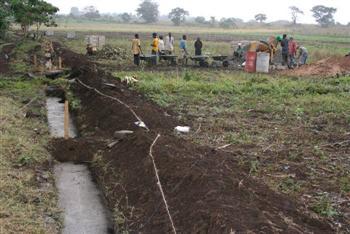
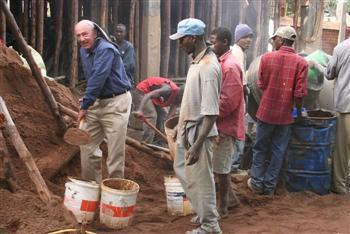
Foundations for security walls on new Usa River campus

This long-term planning will ensure that the school continues to grow in a responsible way to provide high-quality education to the poorest children of the Arusha region.

The rate of growth is reflected in the financial accounts. In 2004 the expenses of the school totalled $US 367,000. In 2005 the expenses were $696,000. This increase would be really scary if support had not grown to match it, especially in Australia. Sponsorship and donations from Australia nearly doubled in one year, from $US240,000 in 2004 to $US 524,000. A further $US81,000 comes from other countries.

This is the most exciting time to be part of this inspiring and energetic project. It is growing so fast that onlookers almost hold their breath in case a misstep causes the project to falter. So, if you have a tolerance for risk, come aboard and lend your support to this phenomenon.

Tuesday, November 21, 2006

Drought and electricity

Our news is full of our drought - worst in 100 years / 1000 years. We've had six years of drought. In Sydney our dam levels are 40%, in the Central Coast they are 12%. It seems dire and we're all worried. The politicians are blaming each other in usual fashion.

But we have plenty of electricity. The trouble is that NSW electricity is produced by burning coal and that throws CO2 into the atmosphere - and that is a major greenhouse gas causing global warming. And THAT brings us back to drought. Maybe this isn't a drought - maybe it is the new 'normal' weather.

Pete – more about him later!

Tanzania and the other East African countries are gripped by severe drought too. Some people are living on food aid. Major dams are empty and huge lakes like Lake Victoria and Lake Tanganyika have low water levels.

Tanzania hasn't been producing electricity by coal and dumping CO2 into the atmosphere, but they are suffering the effects. In fact, they are suffering doubly, because the use hydro electricity powered by water in the dams. Earlier this year, dam water levels fell too low to produce electricity so the country has had power rationing (i.e. blackouts) for 12+ hours a day.

Now THAT will put a dent in the productivity of business! Of course there was a rush on generators and the prices went up.

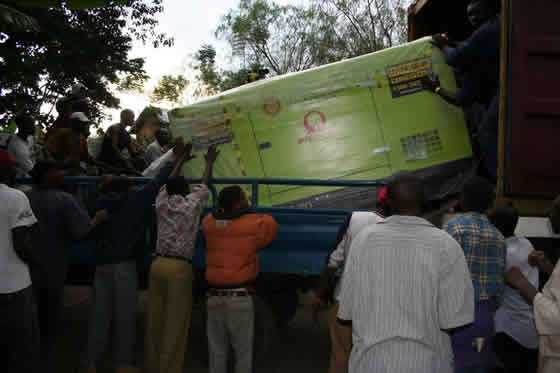
Can you imagine trying to run a school when suddenly it is announced that there will be no electricity next week! Well School of St Jude struggled for a while with the small generator they had. Then the call went out through the school's support networks. Within months the School had two big generators. One was bought by a generous donor and the other was funded by A group of Rotary Clubs.


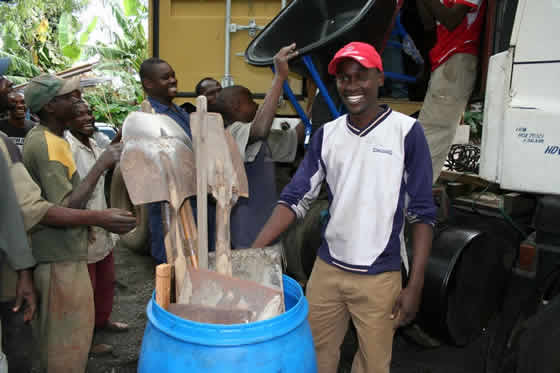
The School finds a use for everything that is given. In the same container as the two diesel generators, the head builder, Pete, was delighted to discover a motor driven cement mixer, wheelbarrows, ladders and armfuls of gardening and building tools! That was him at the top of this blog - smiling right at you!

Monday, November 20, 2006

G20 misses opportunity

World Poverty and Climate Change did not get much attention at G20, disappointing many advocates for the issues.

Apparently the best G20 could manage was --

" support for "well-functioning markets" as the best way of giving countries future access to energy sources and new technologies needed to tackle climate change".

Tim Costello, head of World Vision, and Oxfam Australia chief Andrew Hewett, co-chairmen of Make Poverty History, said delegates and the Australian Government had missed an opportunity to increase aid and deliver new policies to help wipe out poverty.

I'm not sure what one can expect from a couple of days of talks amongst the money men of the 20 countries, but I think something can be gained by leveraging the system at the top end.

The Melbourne Age reports a positive side-meeting on Saturday between Tim Costello and with the World Bank president Paul Wolfowitz for 90 minutes. Apparently Costello came away very impressed. "It's funny to be placing my hope in a neo-con who took us into Iraq when I'm against the war, but I came out thinking this man is concerned about the poor," Costello remarked yesterday.

Perhaps that new trust will enable future activity.

Meanwhile, there are the projects on the ground that are making big differences to vulnerable lives. Yes, School of St Jude is right there, in action. It's a place where your help is valued.

Sunday, November 19, 2006

The best job in the world!

Whatever your skills, you'll find a way to make use of them in a visit to the School of St Jude. Teams of handy men and women have lent their expertise and muscle to the continuing work of putting up classrooms and other buildings to cater for the 170 additional students every year.

When Helen and Gordon Smith visited the school this year they helped with the Friday selection process for new students. But, best of all, Gemma noted that the Smiths are in the building industry and she found it great to show people around who are actually as excited by concrete columns and cement pours as she is!!


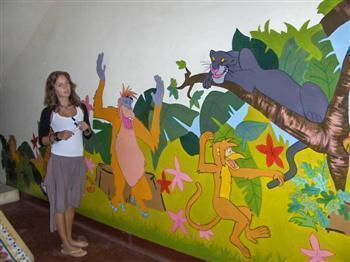
Mandy from Belgium spent time at the school preparing teaching aids. When her daughter Elia visited for three weeks, she looked around for a project that fitted her talents and here is what she came up with.


The sick bay walls will bring cheerful colour to this quiet spot in the school.

What a difference all these many gifts to the school are making. Our financial help, our interest and encouragement, as well as our particular talents and skills add up to one of the most successful projects in Africa. Thanks Gemma for getting it all started, and keeping all the balls in the air!

Saturday, November 18, 2006

Best job ads

Have you heard of this famous newspaper advertisement?

"Men wanted for hazardous journey. Low wages, bitter cold, long hours of complete darkness. Safe return doubtful. Honour and recognition in event of success."

It is reputed to be the job ad placed by either Scott or Shackleton in their race to be the first at the South Pole. While researchers have not been able to locate the ad in any newspapers of the time, Shackleton's letter to the Times in 1913 along similar lines netted 5,000 responses!


Well the School of St Jude is currently advertising several positions: Teacher Trainer, Art Teacher and Music Teacher. They are much like the apocryphal 'hazardous journey' ad. Here is how they go....


POSITION COMMENCING IN JANUARY 2007 FOR TWELVE MONTHS (MIN)
SALARY – approx equivalent to $US 300

We're looking for a volunteer who is a qualified and experienced teacher or head teacher to help set up and run an effective teacher assessment scheme. This will be a continual project, with the aim of helping our Tanzanian staff improve their teaching methods and abilities. You will be required to sit in on teacher’s classes, look at ways to enhance their teaching and then helping them put a pro-active and workable plan in place. The assessment will be ongoing to ensure maximum improvement.

The main qualifications and qualities needed are:-

  • 10 years+ teaching experience (preferable with head teacher or head of department experience)
  • A love of working with children as well as adults
  • Preferably some experience in teaching/training adults
  • A willingness to help in a school that is educating the poorest children in Tanzania, and thereby helping to reverse the downward spiraling poverty cycle in Africa.
  • Patience and Tolerance: The candidate will be living and working at the school with other volunteer staff from various cultures and with a variety of personalities. In Tanzania, we frequently have no power or water. There is dust, dirt and disease everywhere, so it can be very challenging to live here. Hence, the person needs to be able to cope with these conditions in a cheerful way.
  • A sense of humor helps!
  • As a bonus, though it is also very rewarding to be a part of one of the most visionary projects in East Africa today.

** A US$500 payment is required from all volunteers to pay for upkeep of volunteer accommodation, cleaners and admin costs.


With an additional 170 students each year, the school needs extra teachers every year. The teaching staff are a combination of local teachers and volunteers from other countries. As well as teaching the children, the school aims for a high standard of teaching excellence and works hard at capacity building for locally trained teachers.

In 2006, there were around 150 staff at The School of St Jude. Teachers, cooks, bus drivers, cleaners, groundsmen, builders and guards all work together to ensure that as many students as possible are given a chance of a great and free education.

Friday, November 17, 2006

G20 meeting in Melbourne

Today the news is full of the G20 meeting in Melbourne. This is one of the big events on the annual calendar of international political meetings. It brings together finance ministers and central bank governors from the world's 19 richest countries, plus the European Union.

This group keeps an eye on issues relating to international financial stability that go beyond the responsibilities of any one organization. World poverty and climate change are topical issues for this meeting.

The core underlying belief of most participants in this forum is that globalisation and free trade are the best way to combat world poverty.

The importance of trade in lifting poverty is widely held. Kofi Annan has said, "Personally I do not believe that the poor are victims of globalisation. Their problem is not that they are included in the global market but that, in most cases, they are excluded from it".

Economists attribute the recent prosperity of East Asian countries to the economic development delivered by their ‘tiger economies’. This Asian prosperity is so marked that Ross Gittins, Sydney Morning Herald economist, refers to the Africanisation of poverty.

When extreme poverty affects every continent, the problem seems massive. Somehow when there is only one continent as the focus, i.e. Africa, the problem seems more solvable. Suddenly, the impossible can become probable. Like the fall of the Berlin Wall, world poverty really could end in my lifetime.

…………………………

There is a whole counter-culture that sees free trade as part of the problem, not part of the solution to world poverty.

Make Poverty History, a coalition of development, social justice and faith-based groups, calls for more aid, debt relief and fair trade for developing nations, and regards these three principles as key to alleviating global poverty.

I need to read Jeffrey Sachs in more depth. He documents a combination of elements that work together to alleviate poverty. I think he points to a mix of trade, health, education and governance. Better health and education can’t wait for an economy to develop; instead they need to be supported by aid from First World countries.

The UK seems to be taking a lead role in encouraging First World countries to pay attention to the whole mix. A Blair Government representative for this weekend's G20 meeting, Stephen Timms, has come out in strong support of the Make Poverty History campaign. He is deputy to Chancellor of the Exchequer Gordon Brown, and has praised the momentum that Make Poverty History began last year when the G8 summit committed to increase aid by $US50 million and double the amount of aid to Africa by 2010.

Stephen Timms was the only G20 representative to attend the Make Poverty History forum that was held in conjunction with the G20 meeting. Our Howard government seems determined to be a follower, not a leader, in this respect as in so many others.

A report released as part of the Make Poverty History campaign, involving 60 Australian aid agencies, community groups and church groups, shows that all G20 countries, apart from Australia, have increased their overseas aid allocation since 2000. Australia is the least generous contributor to overseas aid among the G20 countries.

Having a government with blinkered views makes it doubly important for individual Australians to be aware of the issues and to support worthwhile projects.

With education as one of the keystones of poverty alleviation, the School of St Jude gives me a clear way to help lift one of the world’s poorest countries out of poverty.

Thursday, November 16, 2006

Malaria

The School of St Jude operates against a background of endemic malaria infection. Children and their families, and staff, are sick from malaria regularly. In her blog about her volunteer work at The School of St Jude, Jacky describes the funeral of Margaret, the wife of Herman, one of the school bus drivers. After suffering from repeated bouts of malaria, Margaret died from the disease.

Fortunately, world attention is focussed on malaria and a number of international agencies fund programs aimed at reducing the impact of malaria on Tanzania and other countries.

  • Life expectancy at birth is 46 years.
  • Under five mortality is 112 in 1,000, and malaria is a major cause.
  • One fifth (22%) of children are underweight by two standard deviations.
  • 30,000 children a year die of malaria.

Insecticide Treated Nets (ITNs) are one of the main weapons against malaria. Large portions of foreign aid are directed towards providing households with ITNs. One successful program in Tanzania provides discount vouchers for pregnant women. These are distributed at local health clinics. This program has had several major benefits:

  • Women attend clinics earlier in their pregnancy and so get better health care.
  • Private businesses that sell ITNs flourish (economic benefits for community).
  • More households have ITNs.

Research has shown that if about 80% of households in a village have ITNs, the level of malaria is almost eliminated because the mosquitos do not have access to infected humans and so cannot transfer the disease. By reducing the number of infected mosquitoes in the environment that are able to transmit malaria, treated nets offer protection up to a range of several hundred metres.

In 2004, 15% of Tanzanian households had an ITN. One goal is that by 2010 80% of children will sleep under ITNs.

If you could protect every child in Tanzania with a treated mosquito net, you could be looking at saving about 30,000 lives a year.

A local textile business in Arusha, A-Z Textiles, has ramped up the production of ITNs to meet the demand created by schemes like the voucher scheme. Last year they produced 1.5million nets.

They say blue is their best-selling colour as it suits the household conditions of the poorest of the poor.

Through education, The School of St Jude aims to improve the lives of children, their families and the nation of Tanzania.


PBS news item on malaria in Tanzania

World Bank report on ITP programs in Tanzania

UK Dept International Development reports on malaria