Wednesday, November 29, 2006

Thanksgiving

When you take up life with someone from another culture, you take on some of their traditions. I live in an Australian-American cultural mix and, though the gap is quite narrow, nevertheless it gives us plenty of scope for enrichment and tolerance. My husband Hal interprets American movies for me. Happy in my ignorance, I didn’t realise I had so many gaps in my understanding. In return, I interpret Australian culture and idiom for him – he has started a list of new phrases. Neither of us realised that Australian language is so idiosyncratic and idiomatic.

How much greater is the gap that Gemma and her team of volunteers have taken on. Although Tanzania is Gemma's adopted country, (see the distinctive African dress she wore on a fundraising trip to USA earlier this year) she acknowledges that she will never be African. She says the School of St Jude could not come about without the partnership of her Tanzanian husband Richard.

Gemma Sisia and Mr Yap at Rotary meeting in USA

The volunteers at School of St Jude report their wonder at encounters with African culture as well as the ceremonies that emerge from the cultural mix in the volunteer accommodation.

It was with great pleasure that I read on Jacky’s blog (see links) about the Thanksgiving Dinner they shared in Arusha.

Thanksgiving chooks for vollies at St Judes

It resonated with my first ever Thanksgiving Dinner, held here in Sydney on our new deck overlooking Australian bushland. Thanksgiving has come into my life through Hal, my American husband. I am sure that he is bemused to celebrate Thanksgiving in summer, with Jacarandas in flower and parrots trilling and singing all around.

I am in awe of those people who seem to be able to reach across wide cultural gaps to give and receive, and to meet the challenges that are involved.

This School of St Jude does more than fight poverty through education, it throws a bridge across a cultural divide and helps us to expand our horizons and live a larger life.

Tuesday, November 28, 2006

Tanzania leads in poverty reduction

Development economists use Tanzania as a measure. If they can haul themselves out of poverty, others can too.

Students at The School of St Jude

According to The Economist, Tanzania is one of east Africa's few good-news stories. The country remains wretchedly poor, inefficient, with little medical care in its remote areas, few roads and with frequent power cuts. But donors, disillusioned by the corruption and/or brutality that goes on elsewhere, are happy to give money to a country that is both peaceful and stable.

The country's GDP growth is expected to be 5.8% this year, rising to 6.7% next year, and inflation has been low for years. Tanzania's relative lack of graft means that some donors now put their money directly into the national budget with few strings attached. Britain has committed to deposit $170m a year into Tanzania's coffers for the next few years—just the kind of predictability of giving that the aid community has called for.

To put this gift of $US170 million into perspective, the NSW Government had a total revenue of $AU41,627million and it budgeted $AU9,667 million for education in 2005-2006.

Seen in this light, the $US170 million from Britain won’t help Tanzania catch up with the developed world, indeed it is barely enough to hold it in its current position at the bottom of the ladder.

Nevertheless, Tanzania has made great strides in education improvement in recent years.


The World Bank reports –


Increased Access : the Net Enrolment Rate (NER) in Tanzania has improved considerably over the past six years, going from 59% in 2000 to 96% in 2006.


Improved Quality: The passrate of students completing primary education, assessed through the Primary School Leaving Examinations (PSLE), has significantly improved. Over the past six years, the Passrate has increased from 22% in 2000 to 62% in 2006. This was achieved thanks to reforms in curriculum content and teaching; increased teacher training, development and deployment; better school support systems; improved ability of schools to purchase textbooks and teaching materials by using grants; and greater community participation in managing school affairs to enhance learning.


These achievements are a massive effort in a country where many village schools have up to four teachers sharing a single classroom – teaching a class in each corner.

Private citizens need to supplement the funding available to the Tanzanian government by supporting good projects. The School of St Jude is a great project that is worthy of your support.

Monday, November 27, 2006

What to give?

Living entirely within our own culture, we live by its standards of 'have' and 'have not'. In Australia, poverty is defined in relative terms. The bottom 10% of Australians are poor in relation to the other 90%. In relation to Africans, they live a life of plenty.

I am not in that bottom 10% and my children are grown so my expenses have dropped dramatically. Yet, even so, I have to remind myself that my surplus can be given away, it does not have to be accummulated or stored in case of bad times.
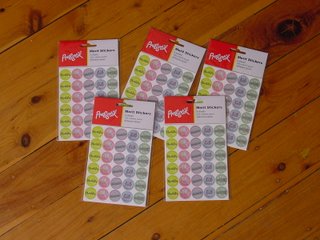
The children at St Jude's love to get stickers.

Charities ask for our help at every corner. Every day there is an approach from someone seeking donations for a very worthy cause. Door knock appeals, ribbon days, bear days, jeans days – all the gimmicks of modern marketing are used to catch our attention and appeal for our donation.

So, there I was, wanting to adjust the balance between my 'have' and others' 'have not'. I was drawn in the direction of supporting a single project. When I heard about the School of St Jude on 'Australian Story', there was no reason to hold back.

Hal, my husband, raised with me the subject of tithing – giving one-tenth of one's income. We decided that we would tithe to the School of St Jude. So, we send a donation each month (income permitting). This is not an automatic transfer, we have to decide to do it each month. That keeps our sense of purpose fresh.

I have to say that our lifestyle is not suffering though our retirement fund won't be as big as it would otherwise have been.

As well as giving a lump of money, we see things for the school all around us and we sometimes buy little things to send in the post. Like the stickers you see at the top of this post.

The school website lists some things that supporters can send for the children at the school.

For boys and girls:

Pens, lead pencils, colour pencils, markers, erasers, rulers and sharpeners always go well. A pencil-case, a dictionary, e.g. Nicholas Awde: Swahili-English, English-Swahili Practical Dictionary (Hippocrene). A school backpack or a library bag. Clothing? Families can get second hand clothing cheaply in the markets in town, but spare dark blue socks or something new is always a treat. Maybe a hat or a cap, a comb, a doll or stuffed animal, action figures or lego. The children absolutely love receiving stickers! If you send something to several children, please make sure the gift is divisible so as to not have arguments about who takes the present home.

For girls:

A skipping rope, inexpensive jewellery (e.g. from a $2-shop) or nail polish. If you send skirts or dresses, be aware that in this culture mini-skirts are not appropriate.

For boys:

A football, a pump for the football, juggling balls, frisbee.

Do not send DVDs, computer games or things that require electricity or batteries. Even though batteries are available here, we do not want the children to then have to ask their parents for batteries.

...........................

We encourage you to send a little of your surplus to the School of St Jude. Even an envelope of stickers in the mail will surprise and delight.

Sunday, November 26, 2006

Rotary Clubs make the difference!

Rotary Clubs have given huge support to the School of St Jude from the very beginning. This support comes in all sorts of ways.
  • Donations – Rotary Clubs in several countries have supported a variety of fund-raising activities.
  • Administration – Rotarians set up the East Africa Fund which allows contributions by Australians to be tax-free. That means that the Australian government is subsidising the school in a major way!
  • Shipping – container loads of goods are shipped from Brisbane thanks to the work and money donated by local Rotary clubs.
  • Physical work – the very first building work on the school site was done by a team of Rotary volunteers. Each year several groups of Rotary volunteers visit the school to contribute their labour and go on safari in the magnificent National Parks nearby.
Rotary visitors on safari


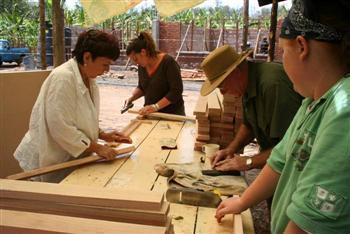
Gemma reports on ‘Operation Desks and Chairs’ for 17 Rotarians in September this year.

Measure twice, cut once!

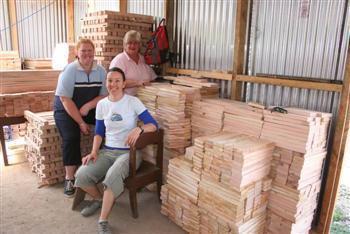
We just pointed them in the direction of a wood pile, thrust tools into their hands and they churned out the components of 200 desks and chairs for the sponsored students who will start school next year.
Considering they had to deal with the glitches of third world living, such as intermittent electricity, it was a massive effort and they really worked hard to earn their 6-day safari.

Smiling satisfaction in a job well done!

And this is what will be made from the cut timber. Of course all the piece will fit together.

The great thing about a successful project like the School of St Jude is that people tell each other about it. Word spreads and support grows. And a few thousand children get a great education.

Saturday, November 25, 2006

Patchwork and quilting

I got bitten by the 'patchwork and quilting' bug a couple of years ago and now I usually have a few projects on the go at any time. I don't have enough time for all the lovely things I want to make, so I have to exert some discipline and not start new things until I finish some others.

'Dragon Princess' 2005

This is shaping up to be a happy week because I will put the binding on two quilts! That means that I can begin to think about my next project. In fact, my next project is all lined up because Blanche and I will go looking for fabric this morning! She would like a cosy lap quilt for her new home. I wonder what she will choose? There are so many things I'd like to try. I enjoy the learning curve of trying new things.

You can check out some of my quilts here at Flickr.

Tanzania has some wonderful fabrics. Women in traditional dress look magnificent in their distinctively patterned cottons. I often wonder about the different patchwork creations that could result from using these fabrics.

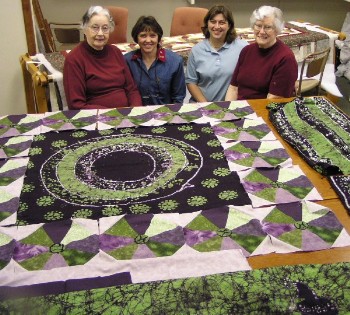
Here is a wonderful story about a group of women from the Weavers Mennonite Church in Virginia, USA, who made a quilt using African fabrics as a fund-raiser for a church in Arusha. Here is the quilt as a work in progress. The quilt sold for $US4,100 in a fund raising auction.


Mennonite traditional quilt patterns and tiny stitches emerge from Arusha traditional batik designs and bright dyes. American women from Weavers Mennonite Church in Harrisonburg, Va., join African women from Arusha Mennonite Church in Arusha, Tanzania, in a vision of sacrificial giving. On both continents, experience and energy sit side by side, visions mingle, and dreams stretch across an ocean. Strangers become sisters, sharing one faith, creating one quilt, contributing one gift.

When we reach out to help others, the pathway of giving and receiving enables us to be touched by higher levels of human potential. Perhaps it is God's work in the world.

Friday, November 24, 2006

Cricket

Bushfires aren't the only sign of summer in Australia. The other big indicator is the start of the cricket season.

Justin Langer opens for Australia in the first test match at the Gabba

Like any seasonal event, cricket sometimes dominates the horizon and sometimes ticks along in the background . This is a BIG year. England is touring and we are determined to win back the Ashes.

England's team are all under 30 years, while Australia is fielding a team of old hands all of whom are over 30, except Michael Clarke, aka 'Puppy'.

I love cricket. The most strategic and complicated game of all sports, it has a grand history of spectacular performances, passions and gaffs as well as a whole rainbow of personalities including players, umpires and commentators.

What are the national sporting passions of Tanzania, I wonder? Perhaps the struggle for a basic existence leaves little energy for formal sport. But then, Ethiopia has cornered the market on long distance running. Maybe the German influence in East Africa planted the seed of soccer in the country.

The kids at the School of St Jude are getting a great education that gives them a world-class foundation in literacy, knowledge and critical thinking, as well as a strong ethical perspective.

Along recruiting and training all the staff, working through many issues, not to mention fundraising and putting up a new building each year, the school is establishing a sports program.
Gemma included the following picture in a recent newsletter.


School of St Jude Football Team

She wrote:
I realised our soccer (or ‘football’ to you non-Aussies!) and netball clubs were training successfully when the leaders asked if they could invite a local school, St Thomas, for some friendly games one afternoon. The whole school enjoyed the spirited performances of all our teams and exerted as much energy off the field as there was on it with singing and barracking for the St Jude’s players! Luckily the scores were pretty even so the St Thomas team should be happy to join us for another great afternoon of exciting soccer and netball later in the year.

There's plenty to celebrate when kids who suffer all the disadvantages of extreme poverty can eat, learn, and play games, thanks to the School of St Jude.

Thursday, November 23, 2006

Bushfire season

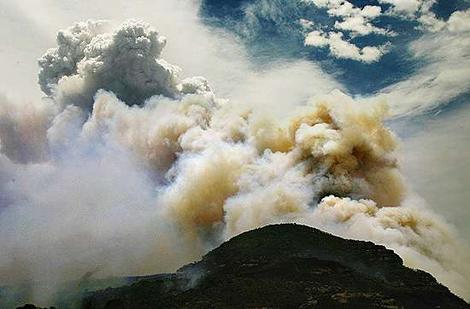
Yesterday we had temperatures around 40 degrees Celsius along with windy conditions. After the driest five years in recorded history, there is plenty of dry material to burn.

Pyrocumulus Cloud: Source: Sydney Morning Herald

There are massive fires burning in the Blue Mountains west of Sydney. We can smell it in the air and the sunsets are spectacular. 20 kilometers of back burning is underway to save Blue Mountain towns like Blackheath.

Across the State 2,000 fire fighters are trying to manage 44 fires. Temperatures have dropped back to the mid-20s, so that may help a bit.

This seems to have been the common story most summers in recent years. We are getting MUCH better at learning how to protect life and property. NSW has come to have total faith in our Fire Commissioner, Phil Koperberg, happily known by some as 'Saint Phil'. He has announced that he will stand for State Parliament next year. We certainly could do with some competence there!

Meanwhile, in Tanzania!
  • A French development agency, Proparco, will invest $US5mill in "small and medium enterprises that promote a stable and efficient economy, invest in health and education, and protect the environment". It seems very little on a national scale, but every little helps. This is how very poor countries make progress – inch by inch.
  • BBC video diary on the Ituja family in Tanzania and thoughts on their life, the world and contemporary culture.
  • Each year more than one million babies in sub-Saharan Africa die before they are a month old because of a lack of essential health care, a U.N. report said on Wednesday (22 Nov).
    "Sub-Saharan Africa remains the most dangerous region in the world for a baby to be born -- with 1.16 million babies dying each year in the first 28 days of life," said the report.
    The document, drafted by nine agencies including the World Health Organisation, said Tanzania is one of six countries in the region to make progress in improving care – reducing neonatal deaths by about 30 percent in the past decade, thanks to increased government spending on basic health care.

The School of St Jude is open for business as usual. People who work there often comment on the joy and willingness of the children. From an early age they have a deep appreciation of the opportunity to learn. Maria Montessori, the great Italian educator, based her teaching system on the observation that children don't need to be forced to learn – they have a natural curiosity. "Follow the child", was her motto. At the School of St Jude, the joy and willingness of the children is an inspiration to all who visit or volunteer.

P.S. Fabulous new word: pyrocumulus....